Culture
Turkish, Greek, and Arabic Coffee Reading: How the Traditions Differ
How Turkish, Greek, and Arabic coffee cup reading traditions differ in brewing, ritual, and interpretation, and what they share as branches of the same practice.
Published September 2, 2026 · 7 min read
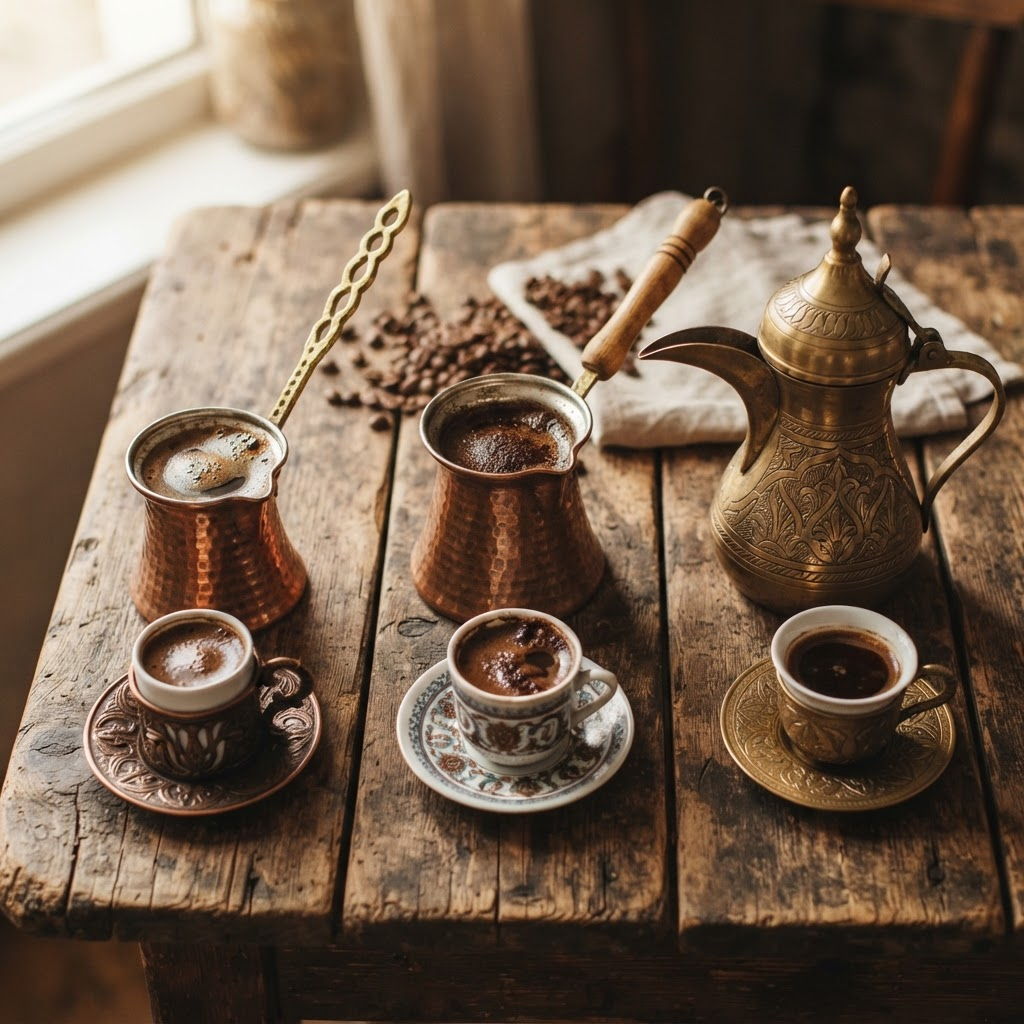
Coffee cup reading did not develop in one place and spread unchanged. As coffee itself moved from the Ottoman court through Greece and into the wider Arab world, each region shaped the ritual and its interpretation around its own coffee, cups, and customs. The symbols overlap far more than they differ, but the details of how a reading unfolds are genuinely distinct.
Turkish Coffee Reading: Kahve Falı
In Turkey, the ritual is called kahve falı and follows a precise sequence: the coffee is brewed unsweetened or lightly sweetened in a cezve, drunk slowly, then the cup is turned onto its saucer to cool for several minutes. Traditionally, a coin is sometimes placed on top of the inverted cup, and the reading only begins once the metal has cooled, which is taken as a sign the grounds have finished settling. Turkish readings tend to weight the saucer as heavily as the cup itself, treating it as a record of the recent past.
Greek Coffee Reading: Kafemanteia
Greek coffee, brewed in a briki using a method nearly identical to the Turkish cezve, is read in a practice called kafemanteia. The main difference is social rather than technical: readings in Greece are traditionally done for and by women in gatherings, often after a meal, with a strong emphasis on discussing love, family, and friendship. The handle-side and opposite-side halves of the cup are read with particular attention to naming friends and family members who might be represented by initials or familiar shapes.
Arabic Coffee Reading
Across the Levant and the Gulf, coffee reading sits alongside a coffee culture built around the dallah, the long-spouted brass or copper pot used to serve cardamom-spiced coffee. Because Arabic coffee is often served lightly and without the same fine, thick sediment as Turkish coffee, some readers prepare a separate, stronger, unfiltered cup specifically for the reading rather than reading the everyday serving cup. Interpretation follows the same core vocabulary of animals, objects, and shapes, with regional variation in which symbols carry the most weight, hospitality and generosity symbols such as a full cup or an open hand often given particular attention.
What All Three Share
Beneath the regional differences sits the same structure: unfiltered coffee, a deliberate swirl, an inverted cup left to rest, and a reading that treats the handle as the person being read and the rim as the near future. Anyone who learns one tradition can recognise the bones of the others immediately. The variations are really about emphasis and occasion, Turkish precision, Greek sociability, Arabic hospitality, rather than a fundamentally different craft.
Whichever tradition you follow, the same photo of your cup works with our AI reader, which draws on the shared symbol vocabulary common to all three.
Read your own coffee cup
Put this guide into practice. Upload a photo of your Turkish coffee cup and get a free AI reading in seconds.
Get my free readingFrequently Asked Questions
Is Turkish and Greek coffee reading the same thing?
They use nearly identical brewing methods and the same core symbols, but Greek kafemanteia is traditionally more social and often practised in group gatherings, while Turkish kahve falı places more weight on the saucer and a formal cooling period.
Why is a coin placed on the cup in Turkish coffee reading?
The coin is a traditional marker used to judge when the cup has cooled enough for the grounds to have fully settled into their final shapes, signalling that the reading can begin.
Do Arabic coffee readings use different symbols?
The core vocabulary of animals, objects, and shapes is shared across all three traditions. Arabic readings often give extra weight to symbols connected to hospitality and generosity, reflecting the wider coffee culture.